Bill's Radio Site
Introduction
to Aero Scanning in the Maritimes
Last
updated January 24, 2017
This
short page will I hope serve as an introduction to aeronautical scanning,
particularly as it relates to the Maritimes region of Canada, and particularly to the Halifax, Nova
Scotia area. My other aeropages
will go into detail regarding various particular topics. This page
presupposes that you already know something about scanning, but not a lot about
aero scanning.
The Maritimes, which is a region
made up of the Canadian provinces of Nova Scotia,
Prince Edward Island and New Brunswick is quite rich in opportunities
to listen in on aircraft movements overhead and as well in and out of our
airports. There are at least three main aspects to the aero
traffic in this region.
First, as in other areas, there is
the commercial traffic in and out of the airports in the region.
Due to this region not having any really large cities there is not a great deal
of this traffic, and consists mostly of Canadian and American regional and
short-range inter-regional services by passenger flights as well as some cargo
service. In this category also fits general aviation including
private and corporate flights, as well as flight school
traffic. In the passenger category you will observe
flights by Air Canada, Jazz,
Exploits Valley
Air Service, Sky Regional, Westjet
and Westjet Encore, Porter, and as well American
feeder airlines such as Endeavor Air and ExpressJet. Also in this
category are a few long-distance regular flights to and from Calgary,
Edmonton, London
and Glasgow.
In the winter season particularly there is also
traffic by these and other airlines to southern
destinations. Additionally there is regular cargo traffic
by Cargojet and Fedex (flown by Morningstar Air Express). Weekly and/or
seasonal cargo flights are flown by Korean Airlines and Yangtze River Express
amongst others. This description is necessarily limited
in scope but that should give a good idea of the situation. Of all
this traffic the largest part goes in and out of Halifax Stanfield
International Airport.
Secondly, there is a huge amount of
trans-Atlantic traffic that flies over the region on its way to and from Europe
and the Middle East. A glance at a
globe will show that the region is right on the path between the eastern
seaboard of the USA and
these areas on the other side of the Atlantic.
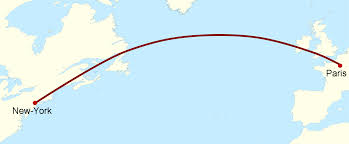 The map to the left shows the route as a curve
but in reality, and as shown on a globe, the path is practically a straight
one. The width of the path is actually
a considerably wider band with a variety of individual tracks chosen on a daily
basis based on wind conditions.
The map to the left shows the route as a curve
but in reality, and as shown on a globe, the path is practically a straight
one. The width of the path is actually
a considerably wider band with a variety of individual tracks chosen on a daily
basis based on wind conditions.
Multitudes of passenger and cargo
aircraft pass over this region every day, mostly in waves occurring at
particular parts of a day, east then west then east in a repetitive cycle, but
almost always with a few going in the opposite direction.
That look at the globe might indicate that in some cases of origin and
destination it would be shorter to fly farther offshore, but in many cases the
airline will prefer to stay over or near land as much as
possible. As to where exactly the trans-Atlantic
flights fly, this is all to do with wind patterns. Therefore
it true to say that they fly over the Maritimes but one day they might be flying
westbound down the spine of Nova Scotia, but the next day this same wave will
be flying down over the Gaspe of Quebec and just barely touching the northern
parts of our region. Regardless of where in any day the
majority fly, there will always be others not in the
crowd. Overall, in the trans-Atlantic traffic you will
encounter a wide variety of airlines ranging from the ordinary like British
Airways and American Airlines and Air France
and Fedex, to the less common such as Azerbaijan
Airways and Air Algerie. But even the
exotic after a while will seem normal, because if an airline flies even one
flight daily and you see it or hear it daily you will get somewhat used to
it. Do not expect to see some of the flights on a consistent
basis, either because they are not regular flights, or in some cases they do
not in fact always fly over our area. A great example is the daily
flight by Tahiti Nui from Los Angeles to Paris.
This is an extremely long-haul service from Tahiti to Paris
with that stop in Los Angeles.
Some days, depending on the wind, that flight will overfly our region, but
other days it might fly a considerably shorter route much farther north over Hudson Bay. It all depends on the wind
patterns.
Thirdly, there are military flights
in and over our region. In the Halifax area there are common helicopter
flights in and out of the base at Shearwater. There are flights as
well connected with the base at Greenwood and as
well some helicopter traffic in and out of CFB Gagetown
near Fredericton.
On a daily basis you will hear American and other military transport aircraft
flying over, more or less being just part of the trans-Atlantic crowd just
mentioned previously, with the difference being that they are not so much
regularly scheduled. You may also hear actual combat
aircraft passing over, though in many cases you might not realize that you are
hearing them. Then as well, in connection with them and as
well transport aircraft, you may hear air to air refueling operations going on
practically right above your head. The United States Air Force commonly carries out
such refueling over Nova Scotia,
and I have a specific page on this topic here on the website.
So, all in all, this is a very rich
area for aero scanning and other types of observation. You
may wish to not limit yourself to just listening. I myself am also
interested in aircraft themselves, so that I have often gone to Halifax Airport and both listened and
watched. Otherwise I commonly follow flights on the computer
using various on-line services that show the identities and locations of civil
aircraft. So I can watch Emirates 324 passing along the spine
of Nova Scotia on the computer screen, listen as the pilot talks to air traffic
control, and if the weather is good, and the path is nearby, go out and watch
it go over me.
For all of this you need at least a
scanner that picks up the VHF aeronautical band. Most scanners do, but
not all are equally good for the task. My old Bearcat BC-590 simple
receiver is my best, but my BCT-15 is also very good. I would not
rate my other scanners nearly as high, and that includes my more sophisticated
BC-396XT that is my mainstay for other kinds of scanning. A good
antenna will allow you to hear aircraft at a distance, and also perhaps ground stations
as well. I use rooftop antennas on a regular basis, and can
hear aircraft over the Gulf of Maine and nearly to Quebec
and Newfoundland.
As mentioned there are alos opportunities to follow
aircraft on-line using your computer or even a handheld device.