This is a small category of Nova Scotia licence plates that
has a few uncertainties for collectors, in terms of
introduction, manufacture, use by department, and serial system.
Any information or opinions you wish to share will be greatly appreciated
I AM ACTIVELY RESEARCHING THIS TOPIC AND HOPE TO PROVIDE
UPDATES AND POSSIBLY CORRECTIONS.
Please message or email me to let me know what restricted plates you have, with serial and type, and if you know what government department or municipality it came from. This will greatly aid my research. Thanks. email is marscan1 AT gmail.com
Restricted plates may be issued for use on vehicles owned by provincial and municipal entities.
Federal agencies and departments are not included. Department of National Defence vehicles
have their own federally-issued plate type, whereas other federal departments use regular Nova Scotia plates.
Restricted plates may be used on a variety of vehicle types including passenger cars, trucks and trailers.
A special smaller sized restricted plate is available for motorcycles, and will be described separately. All initial
comments here refer to the full size plate.
Origins: It is thought that restricted plates were introduced in the 1970's, produced separately "in-house" by the provincial sign shop. They were made of heavy aluminum and flat, essentially the same construction as road signs. It may be that at first they were only issued to the governnment department responsible for highways. This department has had many names over the years, and on this page will be referred to as the Department of Public Works (DPW), the sign shop being part of it. It has been said that that the heavy aluminum plates were specially produced due to highway maintenance vehicles being in a salty environment that was not suitable for regular commercially-produced plates.
It does appear that in the early days these were permanent plates in the sense that they did not have annual or bi-annual renewals and stickers. In more recent years they have had stickers similar to other plates.
The format for all full-size restricted plates is R followed by four digits (R#####). In my observations I have commonly seen plates with digits commencing with 0, 1 and 2. I have also seen a very few commencing with 9. What is not known, at least to collectors, is whether or not there is an allocation system for the serials. I suspect that a certain series or group of series is allocated to the Department of Public Works to produce at their sign shop (see Type 1 below). Otherwise it may well be that people from various agencies go to Access Nova Scotia and obtain whatever is available as needed, as is the case for other types of plates. It is my intent to try to observe more carefully as I see these plates on vehicles and attempt to come up with a pattern.
TYPE 1 PLATES (FLAT HEAVY-WEIGHT ALUMINUM)
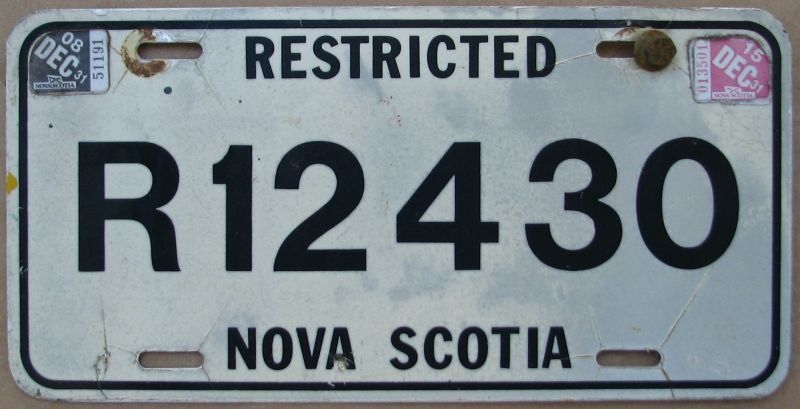 From a DNR trailer |
 From unknown agency |
This is the original type and is produced by the DPW sign shop. Currently it does seem that they are assigned only to DPW vehicles, but it is certain that the flat plates did go to other department vehicles at some point in the past. Note that the first plate shown above was removed by myself (with permission) from a retired Department of Natural Resources fire tank trailer.
Flat plates have been seen with a leading zero. A few have been seen with a leading 9, with each of these belonging to the provincial vehicle compliance branch.
TYPE 2 PLATES (LIGHT-WEIGHT EMBOSSED ALUMINUM with embossed borders and two sticker wells)
Eventually restricted plates began to be manufactured commercially like other plates in the embossed style, but in parallel to continued manufacture of the first type. It does appear to be that the embossed type now goes to departments and municipalities other than DPW.

TYPE 3 PLATES (LIGHT-WEIGHT EMBOSSED ALUMINUM with debossed unpainted borders and one sticker well)

As with other plate types the embossed style changed from being completely embossed, with a border and two outlined sticker wells, to the borderless debossed edge type, and with a different font. I do not have a year for the change however it would likely be after 2011 as that was the year that regular passenger plates had a similar change. Based on the serials on the plates above it appears that the changeover point was approximately R27900, but it is possible that there are multiple groups of serials for different agencies and therefore multiple change points. Both of the plates shown above were from Department of Natural Resources vehicles.
RESTRICTED MOTORCYCLE PLATES
The comments above apply also to restricted motorcycle plates except that the serial on these is R####, i.e. with only four digits.
These plates are very rare as it does seem that the only users would be city police forces. For many years the Halifax Police Department and its successor the Halifax Regional Police have operated a number of motorcycles. Whether or not other municipal police forces have operated motorcycles or still do is a piece of information that I do not have. Note that the RCMP, being a federal force, does not use these plates on its few motorcycles. My conclusion is that there must have been very few of these plates ever issued, with the number being affected by whether or not the original plates have been passed on to replacement machines or not.
I myself do not have one of these plates, and would be interested in seeing photos of such plates in collections or out there mounted on motorcycles. My recollection is that these plates were at first flat, like the full-size ones. I do have a sample or specimen of the modern embossed with debossed edge type, shown below:

FUTURE OF RESTRICTED PLATES
In the beginning these plates were issued free of registration charges and would have been eagerly obtained by fleet managers instead of regular plates. In more recent years they have been accompanied by fees similar to those associated with regular plates. This means that it has become common to see government and municipal vehicles with regular plates, as there is no incentive to obtain the restricted plates, other than if a fleet manager prefers to have them. My conclusion from this trend is that the current debossed type will be relatively scarce on the collector market due to this reduced level of usage. I was told by a DPW manager in 2025 that they were putting regular non-restricted plates on "civilian" type vehicles and flat plates on the actual highway maintenance units.